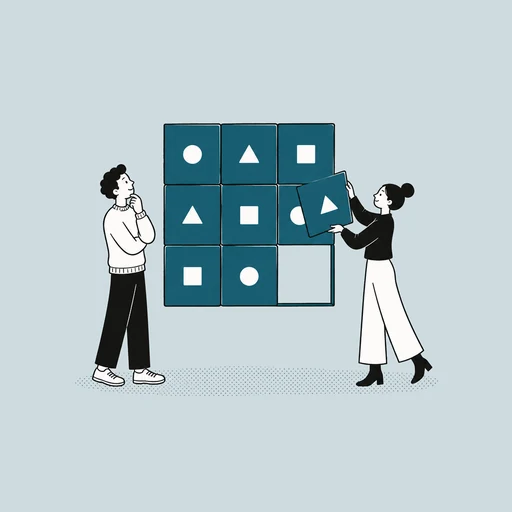
IQ Test: Pattern and Number Puzzles
28 puzzles · about 15 minutes · free in your browser
Your score and its range are free, with no sign-up needed to see them.
Many IQ tests are built around one skill: finding the rule in something you have never seen before. This test asks exactly that, with 28 puzzles of our own in two parts, and it scores right answers only, never speed.
At the end you get your IQ estimate with an honest range, and how many puzzles you solved in each part. The puzzles are new to everyone, and they need no words and no school facts.
It shows how you solved new puzzles today. It is not a measure of your worth, your creativity or what you can learn.
What the test measures
Reasoning researchers have long found that puzzles with a hidden rule are the closest short way to see how someone reasons with something new. This test uses the two kinds that do it best:
- Patterns. 18 grids of three rows and three columns, with one piece missing. Shapes change from picture to picture by a rule, or by two or three rules at once. You pick the piece that completes the grid.
- Number series. 10 rows of numbers that follow one rule. You pick the number that comes next. Digits only, so it reads the same in any language.
The puzzles start easy and get harder. There are no words to know and no facts to remember: what counts is spotting the rule.
A sample puzzle
This is one of the practice puzzles you meet before the test starts. Practice puzzles are never scored. Which piece completes the pattern?
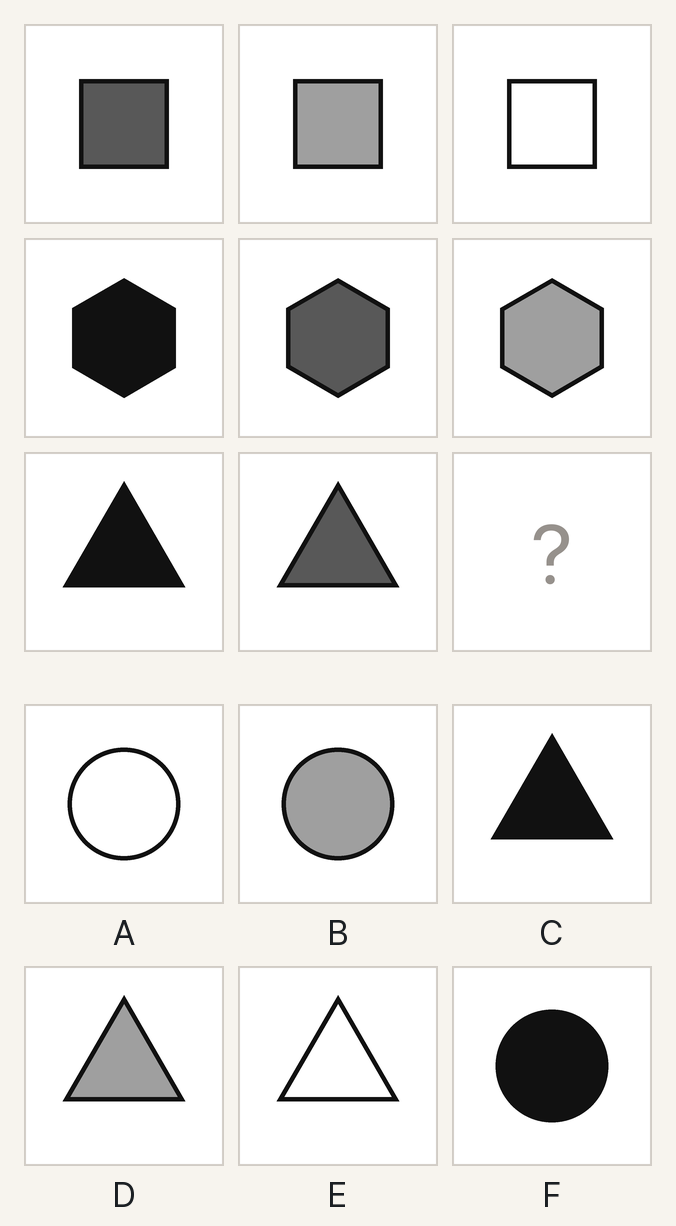
See the answer
F, the dark hexagon. Along each row the shape gets one shade darker, and each row keeps its own shape. The black hexagon, D, is one step too far: the hexagon row starts at white, like the circles, so it ends at dark.
How long it takes
About 15 minutes. First comes a short explanation, an optional age question, a worked example and three practice puzzles with feedback. Then the 18 pattern puzzles and, after one more example and practice puzzle, the 10 number series.
Each puzzle has a generous time limit: two minutes for a pattern and 90 seconds for a series. You only see a countdown in the last 20 seconds. If you leave the app, the clock pauses. A puzzle that runs out of time counts as not answered, and the test moves on. If you are unsure, pick your best guess: a wrong answer costs nothing more than a blank one.
Why you get a range, not one number
Any short test is a little uncertain. With 28 puzzles, a different day, a better night's sleep or one lucky guess can move a score a few points. So your result shows a range, the place your score most likely falls, with the number as its middle. Near the middle of the scale the range is about 12 points either side.
The scale is also new. For now its numbers come from how hard each puzzle's rules are predicted to be, and they will be refined as more people take the test: first tries, kept without anything that names the person, show how hard each puzzle really is. Your estimate is placed against adults of all ages.
Scores on these puzzles peak in the twenties and are not adjusted for age.
Why the score is free
Some IQ sites ask for payment or an email address before they show you the number. We think that if you take the test, the result is yours. So your score, its range and your right answers per part are free, in the app and in your browser.
Premium is for going deeper, if you want to: every puzzle explained, with your answer, the right one and its rule, and a written reading on how you reason.
How the puzzles are made
Every puzzle is our own, made for SlowMind from kinds of rules that decades of reasoning research have studied: a shape that steps in size or shade, the same three shapes in every row, two pictures that add up to a third, lines that cancel each other out. Published test puzzles are protected, and we use none of them.
Each puzzle is checked so that exactly one answer fits every reading of its rule. The wrong answers are balanced, so you can't find the right one by looking for the odd one out among the options. And there are three parallel sets of puzzles, built from the same rules, so a retake never repeats the puzzles you just saw.
Taking it again
You can take the test up to three times, each time with a different set of puzzles. A second try usually scores a few points higher, because the kinds of puzzles feel familiar. That is not a change in how you reason, so your first score stays your score, and later tries show below it as practice. Practice makes puzzles like these familiar. No honest test can promise it raises your IQ.
What this test is not
- Not a clinical assessment. It can't diagnose anything, and no short online test can.
- Not for hiring, selection or school. Please never use it to screen people or to place anyone in a class.
- Not a score for children. The scale is for adults: if you are under 18, your result shows the puzzles you solved and no number.
- Not the whole you. It says nothing about your memory, your knowledge, your creativity, your kindness or what you can still learn.
What you get in SlowMind
- Your IQ estimate with its range on a bell curve, against adults of all ages.
- Your right answers per part, for patterns and for number series, and your time.
- A challenge for a friend. Send them the test and see who solved more puzzles, each of you on your first score. When your scores are close, the card says it plainly: too close to call.
- An optional deeper look in Premium: every puzzle explained, and a written reading on where you were quick, the kinds of rules that slowed you and how you meet something new.
Take the IQ test
Twenty-eight puzzles, about fifteen minutes, and an honest score at the end.
Or in the app, on iPhone or Android:
Frequently asked questions
Is this IQ test free?
Yes. Taking it in your browser is free, and your IQ estimate, its range and your right answers per part are free too, with no sign-up needed to see them. The app is free to download. Premium adds every puzzle explained and a written reasoning reading, and it is optional.
Is this a real IQ test?
It is built the way reasoning tests are built: puzzles that ask you to find a new rule, scored on right answers only, through a table for each set of puzzles. Your result is an IQ estimate with a range, against adults of all ages. The puzzles and the scale are our own, and the scale is new: it will be refined as more people take the test. It is not a clinical assessment, and no short online test can be.
Why do I get a range instead of one number?
Because 28 puzzles are a short test, and every short test is a little uncertain. On another day your score could move a few points either way. The range shows where your score most likely falls; the single number is its middle. A test that gives you one exact number is hiding that uncertainty, not removing it.
Can practice raise my IQ?
No test or app can honestly promise that. Practice makes puzzles like these feel familiar, so a second try usually scores a few points higher, but that is familiarity, not a change in how you reason. That is why your first score stays your score. Rest, sleep and a calm moment help you show what you can do on the day.
Can I take it again?
Yes, up to three times, and each try uses a different set of puzzles built from the same kinds of rules, so a retake never repeats the puzzles you saw. Your first score stays your score: later tries show as practice, because a second try usually scores a few points higher.
Is the score adjusted for age?
No. Scores on these puzzles peak in the twenties and are not adjusted for age: everyone is scored on the same scale, so your score says how you solved these puzzles, not how you compare with people your age. For people under 18 the result shows the puzzles they solved and no number, because the scale is for adults.
Can I use it for school, hiring or a diagnosis?
No. It is for self-discovery only. Please do not use it to select or screen people, to place anyone in a class, or to diagnose anything.
More test guides
 Big Five Personality Test: the five traits behind how you think and act
 Enneagram Test: find your type and what drives it
 Emotional Intelligence Test: how well you read yourself and others
 Core Values Test: what your life actually rewards
 How You Feel Loved Test: the kinds of care that reach you
 Conflict Style Test: what you do when you disagree
 What Makes Sorry Real: the parts an apology needs before it counts for you
 Friendship Dynamics Test: your rhythm as a friend
 Decision-Making Style Test: how you really choose
 Locus of Control Test: who steers your life
 Love Compatibility Test: how you two fit in everyday life
 Personality Type Test: sixteen types on four lines
 Career Test: what work fits you
 Aura Color Test: your personality as a color
 Brutally Honest Personality Test: funny first, then kind
 What Kind of Christmas Person Are You? A short seasonal test
 Your Word for 2027: one word for the year ahead
 New Year Starter Test: and a letter to your future self