 slowmind
The Enneagram Test
36 questions · about 6 minutes · in the SlowMind app
Most personality tests ask what you do. The enneagram test asks why you do it. That single shift, from behaviour to motivation, is what makes the enneagram one of the most quietly revealing maps of personality we have.
If you have ever wondered what is my enneagram, the answer sits somewhere among nine interconnected types, each organised around a core motivation and a core fear. Two people can act almost identically for entirely different reasons, and the enneagram is built to tell them apart.
In SlowMind, the enneagram test is 36 questions and takes about six minutes. This guide explains what the test measures, walks slowly through the nine types, and shows what you will find in your results. A mirror, not advice.
What the enneagram actually is
The enneagram is a model of nine personality types, traditionally drawn as nine points around a circle, each connected to the others by lines. Every type is defined not by how someone behaves but by what drives the behaviour: a core desire the person keeps moving towards, and a core fear they keep moving away from.
This matters because behaviour is a poor fingerprint. Two colleagues might both stay late every evening, one because achievement is how they earn their sense of worth, the other because they cannot bear to let anyone down. Same behaviour, different engines, different types.
A good enneagram type finder therefore does not ask whether you work hard or enjoy parties. It asks what you are reaching for, and what you quietly hope never happens.
The nine enneagram types
Here is each of the nine enneagram types in a single calm sentence. Notice that every one is described by its motivation, not its habits.
- Type 1, the Reformer — principled and self-disciplined, moved by a deep wish to be good and to put things right.
- Type 2, the Helper — warm and generous, moved by a wish to be loved and genuinely needed by the people around them.
- Type 3, the Achiever — adaptable and driven, moved by a wish to feel valuable through what they accomplish.
- Type 4, the Individualist — sensitive and expressive, moved by a wish to be fully themselves and truly understood.
- Type 5, the Investigator — perceptive and private, moved by a wish to feel capable and to understand the world before stepping into it.
- Type 6, the Loyalist — committed and alert, moved by a wish for security and steady ground beneath their feet.
- Type 7, the Enthusiast — spontaneous and optimistic, moved by a wish to stay free and to keep pain at a distance.
- Type 8, the Challenger — decisive and protective, moved by a wish to stay strong and in charge of their own life.
- Type 9, the Peacemaker — easygoing and receptive, moved by a wish for peace, both around them and inside them.
No type is better or worse than another. Each is a coherent strategy for feeling safe and worthwhile, adopted so early in life that it can feel like the only reasonable way to be.
Core fear and core desire
Every type lives on an axis between two poles. The core desire is what the type keeps seeking: goodness for a One, love for a Two, worth for a Three, identity for a Four, competence for a Five, security for a Six, satisfaction for a Seven, self-protection for an Eight, harmony for a Nine.
The core fear is the shadow of that desire, the outcome the type organises its whole life to avoid. The One fears being corrupt or wrong. The Two fears being unwanted. The Three fears being worthless apart from their achievements. And so on around the circle.
An example. A Type 6 Loyalist wants support and certainty, and fears being left without guidance when things go wrong. That one pairing explains their careful planning, their loyalty, their scepticism of easy promises, and their habit of rehearsing worst cases. The behaviours vary; the engine does not.
Wings, briefly
Your main type never works alone. Each point on the enneagram circle sits between two neighbours, and most people lean towards one of them; that neighbour is called a wing. A Nine with an Eight wing carries a firmer, more assertive edge, while a Nine with a One wing is more orderly and principled. The wing does not change your core motivation, it colours how that motivation shows up, which is why two people of the same type can feel noticeably different to be around.
Why motivation-based typing feels so accurate
People often describe their first honest enneagram reading as slightly unnerving, as if someone had been reading their private notes. The reason is simple. Descriptions of behaviour tell you what everyone can already see. Descriptions of motivation name things you have rarely said out loud: the fear you arrange your days around, the reassurance you keep looking for, the particular way you protect yourself.
When a paragraph names the why rather than the what, it lands somewhere deeper, and it stays useful long after the novelty wears off. It also makes sense of behaviour that otherwise looks contradictory, like the confident presenter who cannot accept a compliment, or the peacemaker whose calm is really a way of keeping conflict at arm's length.
What the questions look like
The SlowMind enneagram test uses 36 short statements, and you simply say how strongly each one fits you. Because the test is after motivation rather than habit, the statements do not ask whether you keep a tidy desk. They sound more like this:
"When someone is disappointed in me, it stays with me long after the moment has passed."
Agree strongly · Agree · Not sure · Disagree · Disagree strongly
There are no right answers and no trick questions. The honest response is always the useful one, and the whole thing takes about six minutes.
What you get in SlowMind
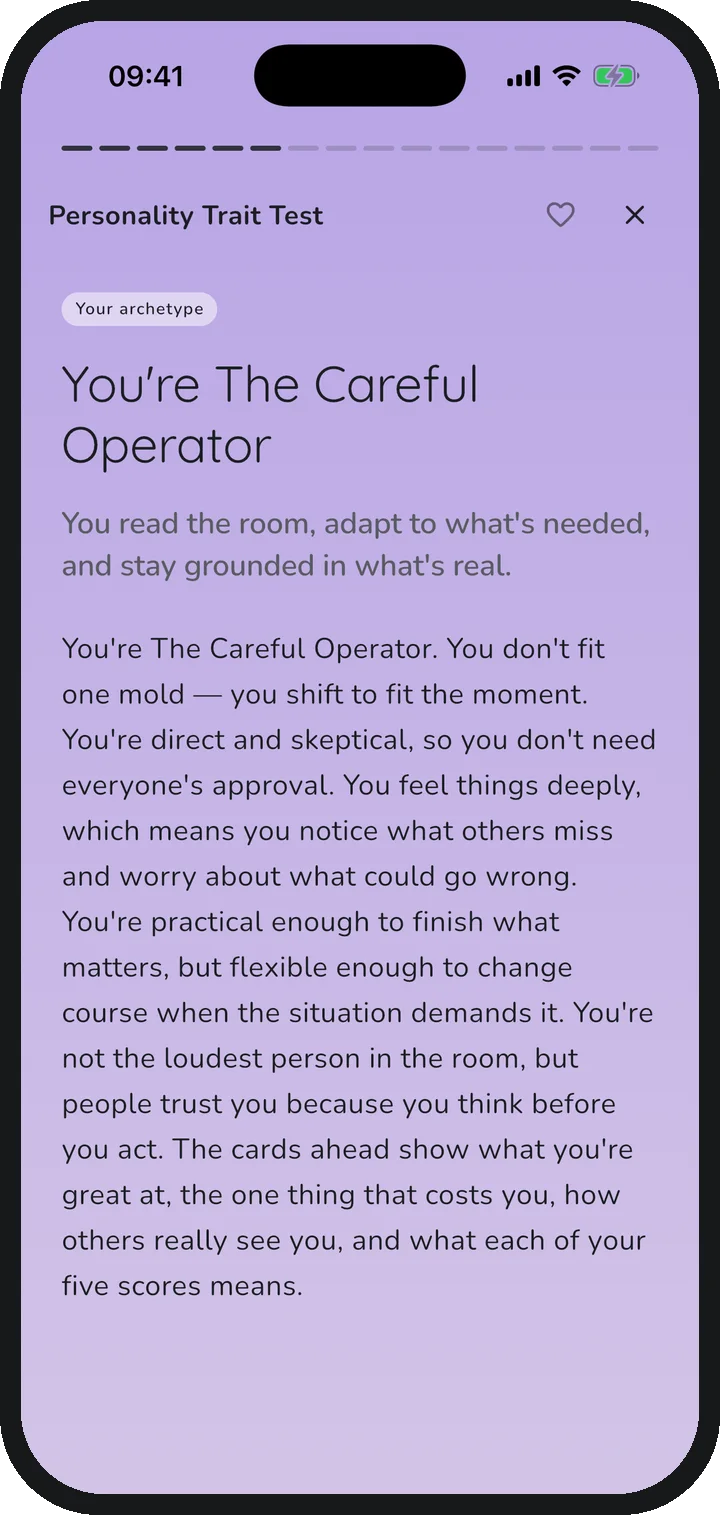
When you finish, SlowMind does more than hand you a type number.
- Your type among the nine, worked out from your 36 answers rather than from a label you picked for yourself.
- A personalised reading, written by AI from your actual answers. It is in plain words, with no jargon and no raw scores, and it reads like a considered letter about how you move through the world.
- Guided audio sessions built around your results, so the insight has somewhere to go instead of sitting in a report.
- Daily insight cards, small reflections drawn from your type that arrive one at a time rather than all at once.
The aim is not to file you away in a box. It is to hold up a clear mirror, then give you quiet, practical ways to work with what you see.
Take the Enneagram Test in SlowMind
36 questions, about six minutes, and a reading written from your own answers.
Frequently asked questions
How long does the enneagram test take?
The SlowMind enneagram test has 36 questions and takes about six minutes. There is no timer, so you can move at whatever pace feels honest.
Is it free?
The app is free to download and your first test is free to try. Premium unlocks every test, full readings, and the audio library.
Can my enneagram type change over time?
Your core type is generally considered stable, because it formed around early and deeply held motivations. What changes is how you express it: with attention, the same type can show up in steadier, freer ways.
What if I relate to more than one type?
That is common, and usually a sign you are reading carefully. Look at motivation rather than behaviour: several types can act alike, but only one core fear will feel like yours. Wings also blend neighbouring types together, which softens the boundaries.
Is this therapy?
No. SlowMind is a tool for reflection, a mirror rather than advice. It is not therapy, diagnosis, or treatment, and it is not a substitute for professional mental health care.