 slowmind
The Attachment Style Test
30 questions · about 5 minutes · in the SlowMind app
Some people relax into closeness. Some reach for it and quietly worry it will disappear. Some keep a careful distance, and some want connection and fear it at the same time. These are not random quirks. Psychologists call them attachment styles, and they tend to follow us from our earliest bonds into adult love.
The attachment style test in SlowMind is a 30-question quiz that takes about five minutes. It looks at how you actually behave when you are close to someone, how you handle distance, reassurance, conflict and trust, and maps your answers onto four well-studied patterns: secure, anxious, avoidant and fearful-avoidant.
It is a mirror, not advice. The point is not to label you or fix you. It is to help you see the shape of your own pattern clearly enough to work with it.
Where attachment styles come from
The idea began with John Bowlby, who noticed that infants are built to seek closeness with a caregiver, and that the way this closeness goes teaches a child what to expect from other people. Mary Ainsworth later observed babies in a gentle experiment called the Strange Situation and found distinct patterns in how they responded when a parent left and returned.
Decades of research since then suggest those early lessons become a kind of quiet template. If comfort was reliable, closeness feels safe. If it was unpredictable, closeness feels urgent. If it was scarce, closeness feels unnecessary or even risky. As adults, we carry these templates into friendships and romantic relationships, usually without noticing them at all.
Asking "what is my attachment style" is really asking a simpler question: what did I learn to expect from the people I depend on, and how does that expectation steer me today?
The four attachment styles
None of these styles is a flaw or a disorder. Each one was once a sensible adaptation to the world a child actually lived in. The styles simply describe different strategies for staying connected.
Secure
Closeness feels comfortable and so does independence. Securely attached people can ask for support without shame and give space without panic. Conflict is unpleasant but survivable, because the underlying trust does not wobble every time there is a disagreement.
Anxious (preoccupied)
Connection feels precious and precarious. Anxiously attached people read moods closely, notice small shifts in tone, and can spiral when a reply takes too long. Underneath is a real gift for attunement, paired with a fear that love has to be monitored or it will slip away.
Avoidant (dismissive)
Self-reliance feels safest. Avoidantly attached people often value their independence deeply and feel crowded when a relationship asks for more vulnerability than they are used to. Needing someone can feel like a weakness, so needs get managed privately instead of shared.
Fearful-avoidant (disorganised)
Closeness is longed for and feared at once. People with this pattern may pull someone in and then push them away, not out of games but out of genuine conflict between two instincts: reach for comfort, and protect yourself from the person you are reaching for. It is the most tiring style to live with, and the most misunderstood.
How your style shows up day to day
Attachment patterns are easiest to spot in ordinary moments rather than dramatic ones.
- In conflict. Secure people can stay in a hard conversation. Anxious people pursue, needing resolution now. Avoidant people withdraw, needing space first. Fearful-avoidant people may do both in the same evening.
- In texting. A slow reply is just a slow reply to one person, a source of dread to another, and a welcome pause to a third. How you feel between messages says a lot about your pattern.
- In intimacy. Styles shape how easily you say what you need, how you receive affection, and whether depending on a partner feels like rest or like risk.
The anxious avoidant secure triangle also explains a familiar relationship dynamic: an anxious partner reaching for reassurance and an avoidant partner retreating from the intensity, each confirming the other's oldest fear. Seeing the loop from outside is often the first step out of it.
Styles can change
Your attachment style is a habit, not a life sentence. Researchers describe people who grew up with insecure patterns and later developed steady, trusting relationships as having earned security. It tends to come from experience: a reliable partner, a good friendship, therapy, or simply years of noticing the old reflex and choosing differently, one small moment at a time.
That is why knowing your pattern matters. You cannot loosen a habit you have never seen.
What the test is like
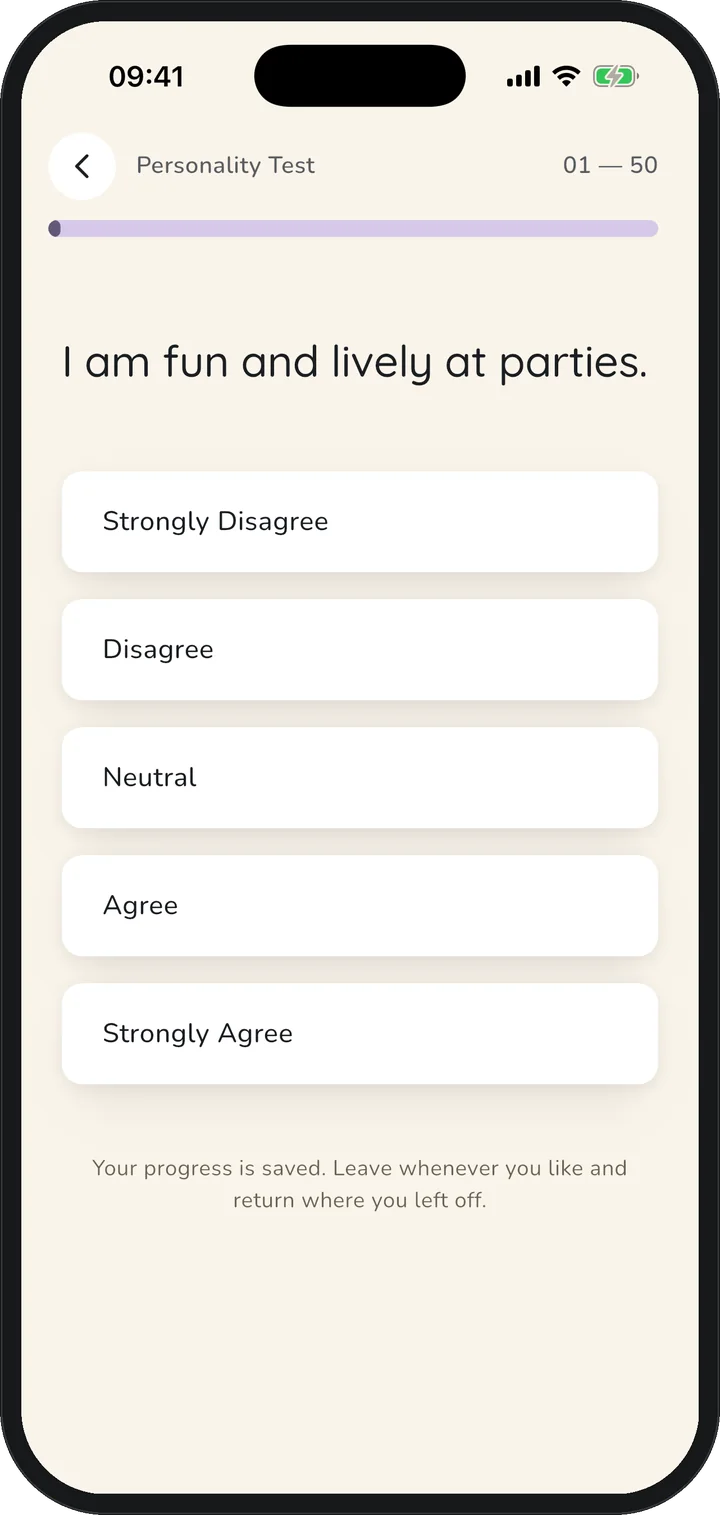
The attachment style test sits in the Relationships category of SlowMind. It presents 30 short statements about how you feel in close relationships, and you rate how true each one is for you. There are no trick questions and no right answers; your first instinct is usually the most honest one.
A sample of the style: "When someone I care about takes a long time to reply, I start to wonder what I did wrong." You answer on a scale from strongly disagree to strongly agree.
What you get in SlowMind
The attachment style quiz is only the starting point. Once you finish, SlowMind gives you:
- Your result across the four styles, showing which pattern leads and how strongly.
- An AI-personalised reading written from your actual answers, in plain words rather than jargon or raw scores. It describes how your pattern tends to play out and where your quiet strengths sit.
- Guided audio sessions built around your results, so the reflection continues beyond the page.
- Daily insight cards that surface one small, relevant observation at a time instead of asking you to remember everything at once.
Take the Attachment Style Test in SlowMind
Thirty questions, about five minutes, and a clearer view of how you love.
Frequently asked questions
Is the attachment style test free?
The SlowMind app is free to download and your first test is free to try. Premium unlocks every test, the full personalised readings and the guided audio library.
Is this therapy?
No. SlowMind is a tool for reflection, not therapy, diagnosis or treatment. It can help you notice your patterns, but it does not replace a qualified professional. If relationships feel painful or unsafe, please reach out to one.
How accurate is an attachment style quiz?
It is a self-report quiz grounded in adult attachment research, so it reflects how honestly you answer. Treat the result as a well-informed snapshot of your current patterns rather than a final verdict on who you are.
What if I seem like a mix of styles?
That is common. Attachment styles are leanings, not boxes, and many people show different patterns with different partners. The test shows which pattern is strongest for you right now, and your reading describes the blend rather than forcing you into one label.
Can my attachment style change?
Yes. Styles are stable habits, not fixed traits. Researchers call the shift towards security earned security, and it tends to come from steady relationships, honest reflection and, for some people, therapy. Awareness of your pattern is usually the first step.