The Personality Type Test
32 questions · about 6 minutes · in the SlowMind app
Free in your browser, with your scores and a short summary at the end.
Four letters, like INFJ or ESTP, have become one of the most shared ways to describe yourself. People put them in bios, compare them with friends, and happily argue about whether a result feels right. The appeal is easy to see: a short code that says something true about how you tend to move through an ordinary day.
The personality type test in SlowMind is our own version. It has 32 questions and takes about six minutes. The questions were written for SlowMind, inspired by Jung's ideas about psychological type. You get your four letters, and, just as important, you see how strongly each letter fits.
It is a mirror, not advice. The point is not to put you in a box. It is to give you a clear, kind way to talk about what you prefer.
What the four letters stand for
Each letter is one side of a line between two ways of being. Four lines give you four letters, always in the same order. We use Jung's own terms for the sides.
Recharging: Extraverted or Introverted (E or I)
Extraverted people tend to get energy from people and activity, and often think out loud. Introverted people tend to get energy from quiet and time alone, and think before they speak.
Noticing: Sensing or Intuitive (S or N)
Sensing trusts what is concrete: details, facts and what has worked before. Intuitive is drawn to patterns, ideas and what could be.
Deciding: Thinking or Feeling (T or F)
Thinking decides with logic, consistency and fair rules. Feeling decides with values and with how people will be affected. Both sides think, and both sides care.
Planning: Judging or Perceiving (J or P)
Judging likes things planned, decided and settled. Perceiving likes things open, flexible and decided as you go. Here, judging means deciding, not being judgmental.
No side is better than another. Every one has its strengths, and the test is written so that none of them sounds like the flattering answer.
Types are positions on lines, not boxes
This is the part most four-letter quizzes skip. Your letters are not two separate camps. Each line runs from one side to the other, and most people sit somewhere along it, not at either end.
That is why your SlowMind result shows where you sit on every line, in plain words: for example, Introverted 78%, strong. It means your answers sat well toward the introverted side. It is not a share of your personality, and it does not compare you with other people. Fifty percent is the exact middle.
When a letter lands close to the middle, the result says so. It is marked as a close call, with a gentle note that both sides fit you and that the letter could change if you took the test again. That is not a flaw in the test. Studies of four-letter tests have found that many people get a different letter on a retest, mostly on lines where they sat near the middle. We would rather tell you that up front.
When you have a close call, SlowMind also shows the nearby types, the ones you get by flipping that single letter, so you can see which descriptions sound like you.
Our own sixteen names
Every type in SlowMind has a name and a one-line description that we wrote ourselves. An INFP is a Gentle Rebel. An ISTJ is a Steady Hand. An ENFP is a Possibility Finder, and an ESTJ is a Practical Organizer. The other twelve are just as plain and warm.
The names describe a quality and a role. None of them ranks one type above another, and none of them is a label to live up to or down to.
What the questions look like
Most quizzes ask how much you agree with a single statement. This one shows both sides of a line at once, because a preference is relative: it is a lean toward one thing over another. Each question gives a short everyday situation and two statements, one at the top and one at the bottom. You tap the one that fits you, or one of the three steps between them, including a true middle. There are eight questions for each line.
A sample of the style: "How do you feel after a day full of people?"
Lifted. I could happily keep going. · Closer to the first · Somewhere in between · Closer to the second · Ready for some quiet time on my own.
Answer as you usually are, not as you wish to be. There are no right answers, and your first instinct is usually the most honest one.
How it relates to the Big Five
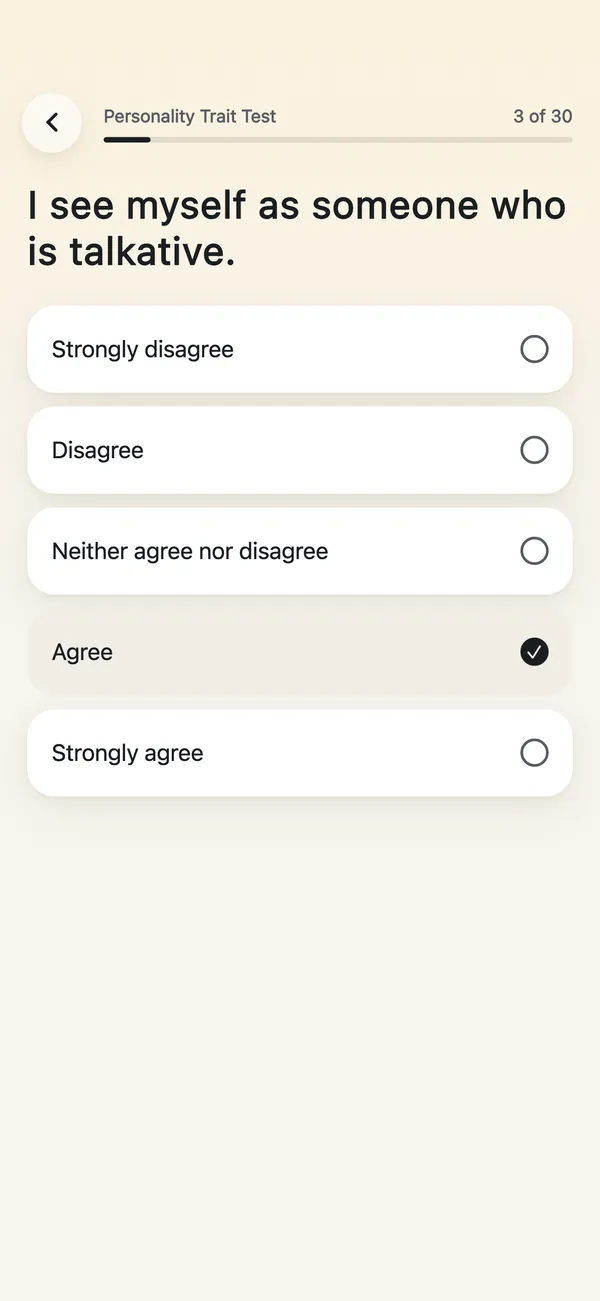
If you like the idea of four letters but want the research version, take the Personality Trait Test, our Big Five. The two tests ask different questions. Personality Type gives you four letters. The Big Five measures five traits on a scale, so you can see how strongly each one shows.
They are related. We wrote the Personality Type questions to line up with four of the Big Five traits: extraversion, openness, agreeableness and conscientiousness. The Big Five also measures a fifth, emotional sensitivity, which the four letters leave out on purpose. Many people take both and enjoy seeing where the two pictures agree.
What it is for, and what it is not
Everyone uses both sides of every line. Your letters show which side you reach for more often. A type is a simple way to talk about what you prefer, not a rule about who you are.
Use it to understand yourself, not to sort other people. It is not for hiring, for picking teams, or for choosing partners, and it is not a scientific measurement.
What you get in SlowMind
When you finish, SlowMind gives you more than four letters:
- Your type, with its name and one-line description. A letter that is a close call is shown as one.
- Your four lines, with where you sit on each and how strong the lean is: close to the line, clear or strong.
- Your close calls and nearby types, so you can see which neighboring descriptions may also sound like you.
- A personalized reading, written from your actual answers, in plain words. It treats a close-call letter as both sides, not one.
- Daily insight cards, one small observation at a time.
Take the Personality Type Test in SlowMind
Thirty-two questions, about six minutes, and a clearer picture of where you sit on four lines.
Or in the app, on iPhone or Android:
Frequently asked questions
Is the personality type test free?
You can take it free in your browser and get your four letters, your score on each line and a short summary at the end. The app is also free to download, and every test is free to take, with your scores for each part. Premium unlocks every written reading, with its insights and its course.
Is this therapy or a clinical tool?
No. SlowMind is a tool for reflection, not therapy, diagnosis or treatment. The Personality Type test is our own, written for self-understanding. It is not a scientific measurement, and it should not be used for hiring, team selection or choosing partners.
Is this the same as the official test behind the famous four-letter types?
No. It is an original test written for SlowMind, inspired by Jung's ideas about psychological type. The questions, the sixteen type names and the descriptions are all our own, so your letters may not match a result from another site, and that is normal.
Why does my result say a letter is a close call?
Each line runs between two sides, and your answers sat close to the middle of this one. Both sides fit you, and which one shows can depend on the day, the place or the people. If you took the test again, that letter could change, so SlowMind also shows the nearby types you may recognize.
How is this different from the Big Five test?
Personality Type gives you four letters from four lines between two sides. The Personality Trait Test, our Big Five, measures five traits on a scale, so you can see how strongly each one shows. Many people take both: the letters for a quick, shareable picture, the Big Five for the research version.
More test guides
 Big Five Personality Test: the five traits behind how you think and act
 Enneagram Test: find your type and what drives it
 Emotional Intelligence Test: how well you read yourself and others
 Core Values Test: what your life actually rewards
 How You Feel Loved Test: the kinds of care that reach you
 Conflict Style Test: what you do when you disagree
 What Makes Sorry Real: the parts an apology needs before it counts for you
 Friendship Dynamics Test: your rhythm as a friend
 Decision-Making Style Test: how you really choose
 Locus of Control Test: who steers your life
 Love Compatibility Test: how you two fit in everyday life
 Career Test: what work fits you
 Aura Color Test: your personality as a color
 Brutally Honest Personality Test: funny first, then kind
 What Kind of Christmas Person Are You? A short seasonal test
 Your Word for 2027: one word for the year ahead
 New Year Starter Test: and a letter to your future self