 slowmind
The Core Values Audit
30 questions · about 5 minutes · in the SlowMind app
Ask most people to name their values and the answers arrive quickly: family, health, honesty, freedom. Ask their calendar and their bank statement instead, and a different list often appears. A core values test is only useful if it can tell those two lists apart.
The Core Values Audit in SlowMind is a 30-question personal values assessment that takes about five minutes. It does not ask what you admire. It looks at the choices you actually make, the trade-offs you accept without noticing, and ranks what your life currently rewards. A mirror, not advice.
If you have ever typed "what are my values" into a search bar and been handed eighty noble words to circle, this works differently. Circling words tells you what sounds good. An audit tells you what is true.
Why stated values and lived values drift apart
Nobody sets out to live against their values. The drift happens quietly. You take a job for sensible reasons and it slowly claims your evenings. You keep a routine because it is comfortable, not because it still serves you. Each small choice is defensible on its own. Added together, they can build a life that reflects convenience, habit, or other people's expectations more than anything you would put your name to.
Stated values also drift for a simpler reason: they are social. Saying you value family, growth, or integrity costs nothing and earns approval. Living those values costs time, money, and comfort. Under pressure, the calendar tells the truth. A personal values assessment is worth doing when you suspect the story and the schedule no longer match.
That mismatch is not a moral failure. It is usually just a lack of measurement. Most people have never looked at their own trade-offs directly, so they navigate by an old self-image instead of the person they have become.
How a values audit works: trade-offs, not wish lists
The common way to "find your values" is a word list. You are given a page of admirable nouns and asked to keep ten. The problem is that nothing is at stake. Adventure, security, creativity, connection: of course you want them all. A wish list produces a portrait of your ideal self, which is precisely the self the exercise was supposed to see past.
A values audit works differently. It puts values in competition, because that is how life presents them. Time given to ambition is time not given to rest. Honesty sometimes costs harmony. Generosity competes with security every payday. When a question forces a choice, the answer stops being flattering and starts being informative.
The Core Values Audit asks about recent, concrete behaviour: what you protected when the week got crowded, what you spent discretionary money on, which compromises you made easily and which ones nagged at you afterwards. From those small, real decisions it builds a ranking of what you value now, not what you once circled on a worksheet.
What a ranked list changes
A ranked list matters more than a set. Ten unordered values give you no help on a hard day, because hard days are exactly when values collide. Knowing that, right now, autonomy sits above security for you, or that connection outranks achievement, turns an agonising decision into a comparison. You are no longer asking "what do I want" from scratch every time; you are checking a choice against an order you have already seen in your own behaviour.
It also works backwards. Old decisions that seemed irrational often make sense once you can see the value they were quietly protecting. And when the ranking surprises you, say status higher than you would like or health lower, you have something specific to sit with. You cannot adjust what you have never named.
None of this tells you what to do. A mirror shows the room as it is; where to move the furniture remains your call.
Values shift with the seasons of life
A core values test is a snapshot, not a verdict. What your life rewarded at twenty-five is rarely what it rewards at forty. New parents watch freedom slide down the list while security climbs. A loss can put connection above everything else for a year. A career change can promote learning overnight. None of this is inconsistency; it is a life responding to its season. It is also exactly why the audit is worth retaking.
The only rule is to retake it honestly. Answer from the life you are living this month, not the one you are planning to start soon. A flattering result teaches you nothing. An accurate one occasionally stings, and is useful for precisely that reason.
What the questions feel like
The questions are short and concrete. There are no abstract riddles and no obviously right answers. A typical one looks like this:
You have one genuinely free evening this week. Based on the last month, not your best intentions, what are you most likely to do with it?
Others ask you to choose between two reasonable options, or to recall how a recent trade-off actually went. Thirty questions in this style take about five minutes, and the honest version is no slower than the polished one.
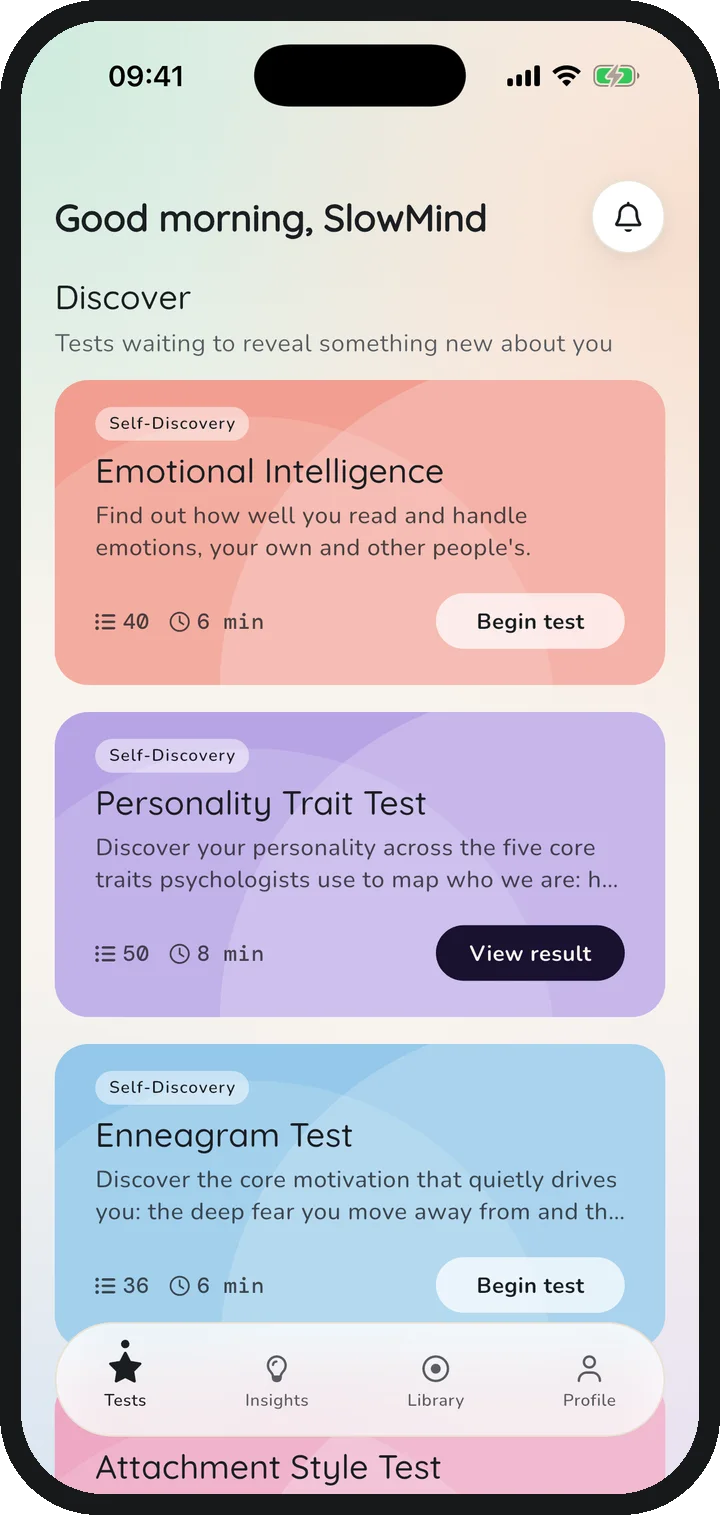
What you get in SlowMind
The Core Values Audit sits in the Values & Decisions section of SlowMind. When you finish, you receive:
- A ranked reading of your current values, written from your answers by AI in plain words. No jargon and no raw scores, just what your choices suggest, where the tensions sit, and what the order might explain about recent decisions.
- Guided audio sessions built around your results, for the values you want to move up the list rather than merely admire.
- Daily insight cards that keep the findings in view, one small reflection at a time, so the ranking does not fade the way worksheet exercises tend to.
The reading is personal in the literal sense. It is generated from your own answers, not pulled from a stock paragraph assigned to a category.
Take the Core Values Audit in SlowMind
Five unhurried minutes, and a clear look at what your life is actually organised around.
Frequently asked questions
How long does the Core Values Audit take?
It is 30 questions and most people finish in about five minutes. There is no timer, so you can take longer if a question deserves more thought.
Is it free?
The app is free to download and your first test is free to try. Premium unlocks every test, full readings, and the audio library.
Is this therapy?
No. The Core Values Audit is a tool for reflection. It is not therapy, diagnosis, or treatment, and it is not a substitute for professional support if you need it.
How is this different from picking values from a word list?
Word lists measure what sounds good to you, and almost everyone circles the same noble words. The audit uses trade-offs and recent everyday choices, so it measures what you actually protect when values compete.
How often should I retake it?
Whenever life changes shape: a new job, a new relationship, a move, a loss. Many people retake it once or twice a year. The point is an honest snapshot of now, not a better score.