 slowmind
The Friendship Dynamics Test
25 questions · about 4 minutes · in the SlowMind app
Some people send the first message after every silence. Some go quiet for three months and pick up exactly where they left off. Some never forget a birthday and still take a week to reply. Everyone has a rhythm as a friend, and most of us have never seen our own.
The Friendship Dynamics test in SlowMind is 25 short statements that take about four minutes. It looks at how you actually do friendship across five sides: reaching out, going deep, showing up, needing space and keeping it even. You see your full breakdown, where your rhythm is likely to clash with a friend's, and what you give without being asked.
If you have ever searched "what kind of friend am I" and been sorted into a single cartoon type, this works differently. A breakdown of five sides shows how you actually behave, and why some friendships feel easy while others take work. There is nothing here to pass or fail.
Why good friendships can still feel uneven
When a friendship starts to feel one-sided, the usual question is who cares more. Often that is the wrong question. Two people can care equally and still run on very different rhythms.
Picture two old friends. One messages every week and feels a month of silence as a small loss. The other goes quiet for a season, then rings as if no time has passed. To the first, the gap looks like drifting apart. To the second, it is a sign of trust. Neither is wrong. They read one silence in two ways.
Much of the friction between good friends is not a shortage of care. It is two rhythms that have never been named out loud.
The five sides of how you do friendship
Everyone uses all five to some degree. Nobody is high on all of them, and nobody needs to be.
Reaching out
Starting plans, sending the first message, keeping contact going. High scorers text first after a silence and turn "we should meet up" into a date. Low scorers are warm when someone gets in touch, but rarely make the first move.
Going deep
Real talk, opening up, and a few close friends over many. High scorers leave an evening of small talk still hungry. Low scorers like friendship light and easy, and show closeness through company and fun.
Showing up
Practical loyalty: turning up when it counts, remembering, following through. High scorers carry the boxes on moving day. Low scorers care just as much, but dates and plans can slip.
Needing space
Comfort with distance, long gaps and time alone. High scorers can let months pass and feel the friendship hold. Low scorers like steady contact, and a few quiet weeks feel long. A high score here is not caring less.
Keeping it even
Noticing the give-and-take: who calls, who listens, who makes the effort. High scorers notice whether a friend asks about their life too. Low scorers do not keep count. They give freely, and can miss the moment a friend feels the balance has tipped.
Where the five sides come from
There is no single, agreed model of "friendship types" in psychology, and this test does not pretend otherwise. The five sides are SlowMind's own lens, informed by familiar ideas: that friendships are kept alive by contact, that closeness grows as people open up, that trust rests on being dependable, and that the give-and-take should feel roughly fair. Needing space adds one more: people differ a great deal in how much contact and time alone they want.
So treat your result as a careful mirror of how you have been as a friend lately, not a validated scale or a verdict on who you are.
Your mix matters more than any single score
A friend who starts every plan but needs long quiet stretches is very different from one who rarely texts first but never misses a birthday. The mix is where you become recognisable.
Your reading pays particular attention to rhythm: how reaching out sits against needing space. Some people run steady and notice a silence before anyone else. Some go quiet for months and pick up as if nothing happened. Some come in warm waves followed by quiet, and some rarely start contact but are fully there when someone else does.
It also names a habit almost everyone shares: judging a friend's care by your own strongest habit. If showing up is your way, you count who came. If reaching out is your way, you count who texted first. A friend who cares differently can then look as though they care less.
What the questions feel like
Each question is a short, everyday statement about you as a friend, and you rate how true it feels. A typical one looks like this:
If a friend is silent for a month, I assume they're just busy.
Strongly Disagree · Disagree · Neutral · Agree · Strongly Agree
Go with your first instinct, and answer as the real you of the past month, not the friend you wish you were. A few statements are worded the other way round on purpose, so it pays to read each one.
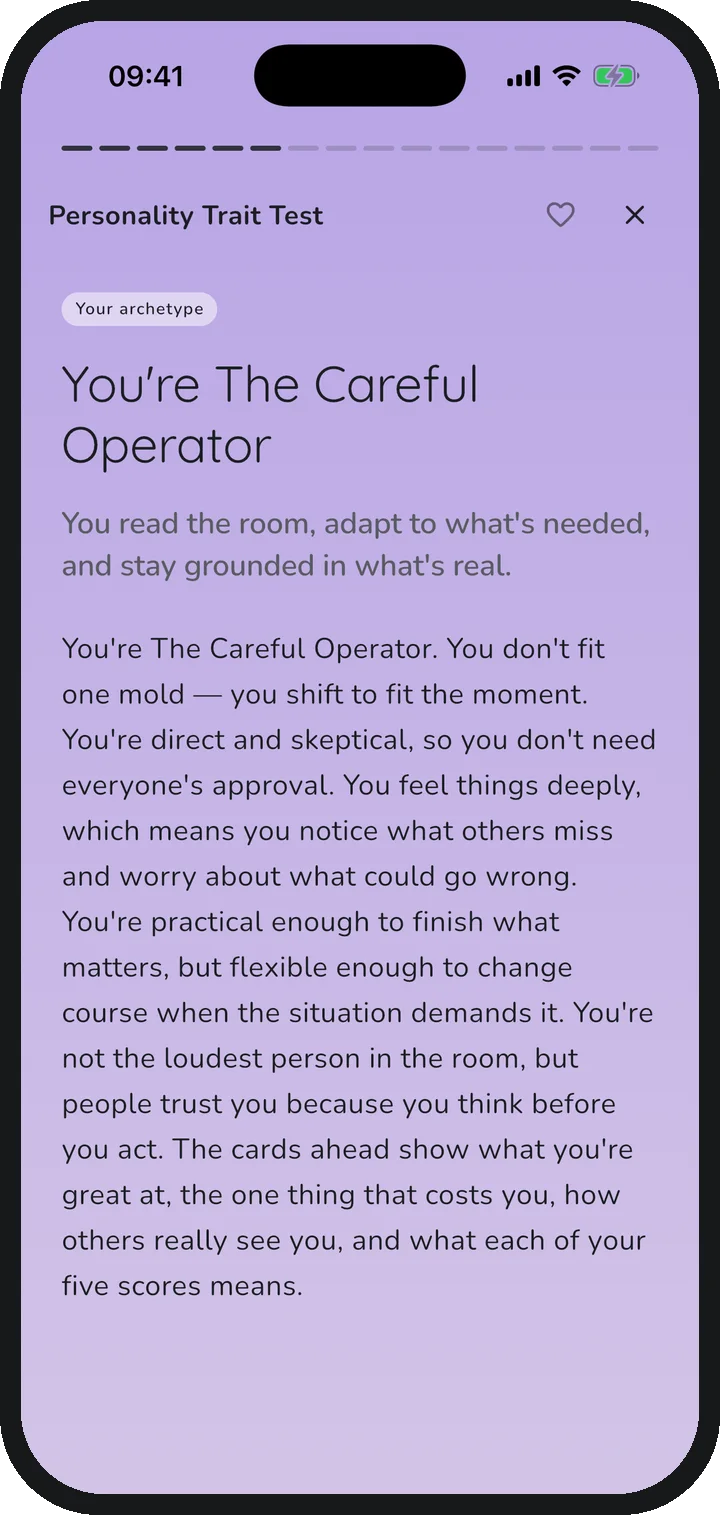
What you get in SlowMind
Friendship Dynamics sits in the Relationships section of SlowMind. When you finish, you receive:
- Your full breakdown across all five sides, shown as percentages, so you can see the side you lead with and the side you use least.
- A personal reading written by AI from your own answers, in plain words. It names your rhythm, what you give without being asked, the side you barely use, where your rhythm is likely to clash with a friend's, what close friends may never say they need, and one small way to stay close on purpose.
- Insight cards to keep and return to, short lines drawn from your result, so it stays in view after the first read.
- Guided audio courses picked for your result. There are three, each six short sessions: Always the One Who Calls, for the friend who usually goes first; Close From a Distance, for friendships that go quiet and stay close; and The Friends Who Stay, for the friend who always turns up.
Take the Friendship Dynamics test in SlowMind
Four unhurried minutes, and a clear look at the kind of friend you already are.
Frequently asked questions
How long does the Friendship Dynamics test take?
It is 25 questions and most people finish in about four minutes. There is no timer, so you can take longer if a question brings a particular friend to mind.
Is it free?
The app is free to download, and your first test, the one chosen for you when you join, is free. Premium unlocks every test, full readings and the audio library.
Is this therapy?
No. Friendship Dynamics is a tool for reflection. It is not therapy, diagnosis or treatment, and it is not a substitute for professional support if you need it.
Is this a validated psychological scale?
No. The five sides are SlowMind's own lens on friendship, informed by familiar ideas rather than a single agreed model. Treat your result as an honest snapshot to reflect on, not a clinical measurement.
Does a high Needing space score mean I care less about my friends?
No. It describes how much contact and time alone feels right to you, not how much you care. Some of the most loyal friends need the most room.
How often should I retake it?
Whenever your friendships change shape: a move, a new job, a friend drifting away or coming back. The point is an honest picture of now, not a better score.