 slowmind
The Conflict Style Test
25 questions · about 4 minutes · in the SlowMind app
Ask people how they handle a disagreement and most give a reasonable answer: they listen, they stay calm, they look for something fair. Ask the people they disagree with and the picture changes. One goes quiet. One keeps pushing. One says sorry first, just to make it stop.
The Conflict Style test in SlowMind is a 25-question quiz that takes about four minutes. It looks at what you actually do when you disagree with someone who matters to you, whether that is a partner, a friend, a relative or a colleague, across five styles: collaborating, competing, compromising, avoiding and accommodating.
Everyone uses all five. What makes you you is the mix, and the move you reach for first when things heat up. No style is better than another; each one fits some moments. A mirror, not advice.
The five conflict styles
The five styles follow the well-known model of conflict handling described by Kenneth Thomas and Ralph Kilmann in the 1970s. It rests on two quiet questions in every disagreement: does my side get said, and does their side get room? Each style answers them differently.
Collaborating
Working it through together until both people get what matters to them. Your side gets said and theirs gets room. It is thorough, but it takes time and energy, and to someone who needs a pause, "can we talk about this now?" can feel like pressure.
Competing
Standing your ground and pushing for your view. Useful when something needs defending or a decision cannot wait. The risk is winning the point and losing a little closeness on the way.
Compromising
Meeting in the middle and trading so everyone can move on. It is quick and feels fair, but a halfway deal on something that needed a proper conversation tends to bring the same issue back.
Avoiding
Stepping back, changing the subject, waiting for it to pass. Sometimes that is wise: not every disagreement deserves a fight, and some go better after a night's sleep. As a habit, it can leave the real issue growing quietly underneath.
Accommodating
Giving way to keep the peace or protect the relationship. It is generous and often kind. Done every time, it can mean the people closest to you never learn what you actually wanted.
Why your mix matters more than your label
Most quizzes hand you one word, but two people can share the same top style and still argue in completely different ways.
Picture two people whose first move is to step back. The first also gives way easily: they keep the peace, drop the point, and the other person may never know there was a disagreement. The second also scores high on competing: they stay quiet until it all comes out at once over something small. Same default, very different evenings.
That is why each style is scored on its own scale, so several can be high at once. Your result shows the whole spread: your default, your backup, and the style you rarely use, which may be the very move your most repeated argument is missing.
When your style meets someone else's
A disagreement is two styles meeting, and some pairings rebuild the same argument again and again.
When someone who pushes meets someone who steps back, the more one presses, the more the other pulls away. One feels ignored; the other feels chased. When two people who give way meet, nobody says what they want, so nobody gets it. When someone who likes to talk things through meets someone who needs time, the conversation one of them needs is exactly the one the other wants to skip.
None of these loops means anyone is doing it wrong. They are simply predictable, and your reading looks at the one your own mix is most likely to walk into.
A snapshot, not a verdict
The SlowMind test is its own short questionnaire, written for everyday relationships. It is not a clinical tool or a published, validated scale, so treat your result as an honest snapshot of how you have been handling disagreement lately.
A conflict style is a habit, not a sentence. Most people disagree differently at work than at home, and differently when tired than when rested. Your mix this month may not be your mix next year, which makes the test worth retaking after a big change.
What the questions feel like
The test presents short statements drawn from everyday disagreements with partners, friends, family and colleagues. You rate how true each one is for you. There are no trick questions and no right answers. A typical one looks like this:
"When a family conversation starts turning into an argument, I change the subject." You answer on a five-point scale, from strongly disagree to strongly agree.
Answer with your first instinct, as the real you of the past month, not the person you wish you were. The honest version is no slower than the polished one.
What you get in SlowMind
The Conflict Style test sits in the Relationships section of SlowMind. When you finish, you receive:
- Your full breakdown across the five styles, with a percentage for each, so you can see your default, your backup and the style you rarely use.
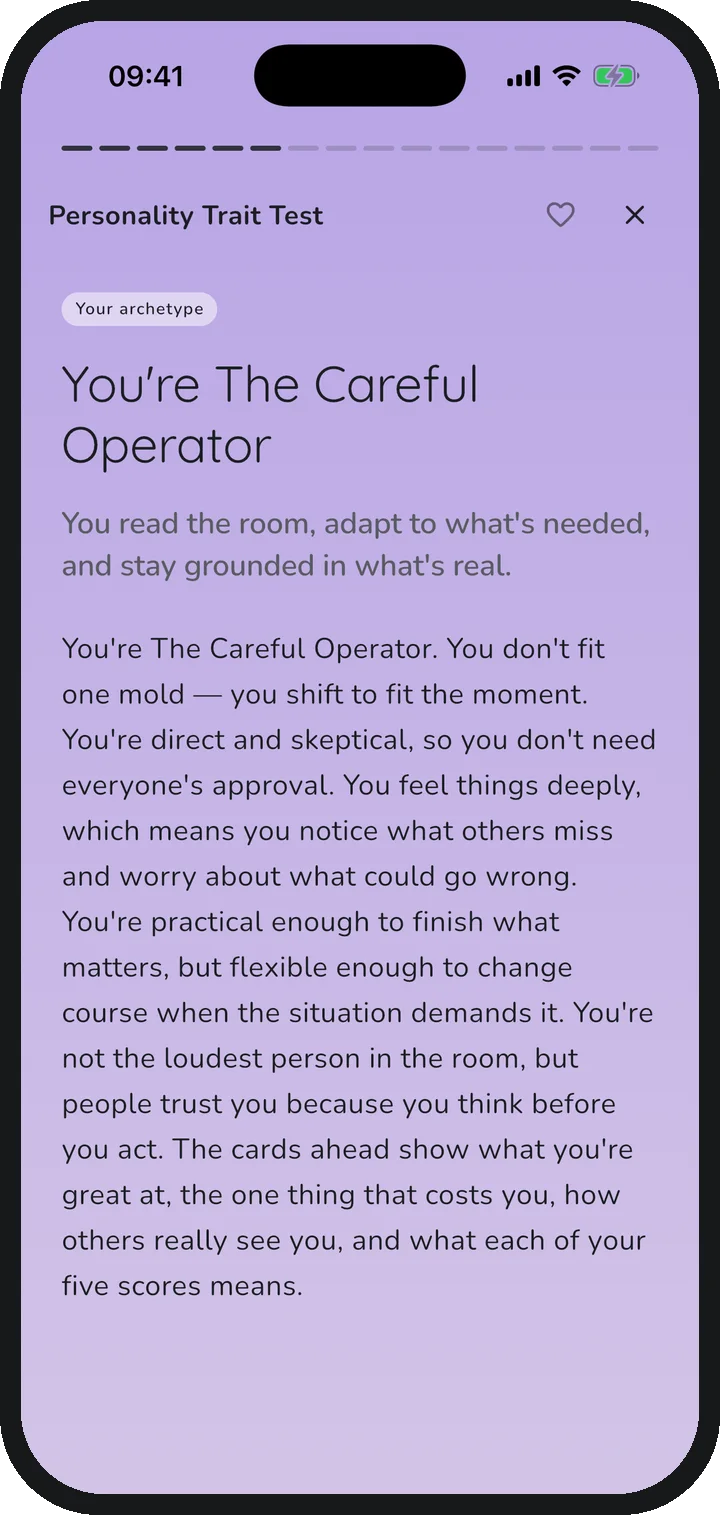
- A personal reading, written by AI from your own answers in plain words. It covers your mix, what you do when a disagreement heats up, what happens when your default meets someone else's, what your style protects and costs, and one small experiment to try.
- Insight cards you can keep and return to, each one a short observation drawn from your result.
- Guided audio courses picked for your result. There are three, each with six short sessions: Hold Your Ground Gently, for people who lead by pushing for their view; Say It Anyway, for people who step back or give way; and Both Sides Heard, for people who talk it through or meet in the middle.
The reading is generated from your own answers, not pulled from a stock paragraph assigned to a category.
Take the Conflict Style test in SlowMind
Four unhurried minutes, and a clearer look at what you actually do when you disagree.
Frequently asked questions
How long does the Conflict Style test take?
It is 25 questions and most people finish in about four minutes. There is no timer, so you can take longer if a question deserves more thought.
Is it free?
The app is free to download, and your first test, the one chosen for you when you join, is free. Premium unlocks every test, full readings, and the audio library.
Is this therapy?
No. The Conflict Style test is a tool for reflection. It is not therapy, diagnosis, or treatment, and it is not a substitute for professional support if you need it. If a relationship feels frightening or unsafe, that is not a question of style, and talking to someone qualified is the right next step.
Is it based on the Thomas and Kilmann model?
The five styles follow the well-known model described by Kenneth Thomas and Ralph Kilmann in the 1970s. The SlowMind test is its own questionnaire, written for everyday relationships. It is not their official assessment.
Is one conflict style better than the others?
No. Each style fits some moments and gets in the way in others. What matters is knowing your default, so it becomes a choice rather than a reflex.
Will I see my scores?
Yes. You see a percentage for each of the five styles, and your reading explains in plain words what those numbers mean together.