 slowmind
The Big Five Personality Test
50 questions · about 8 minutes · in the SlowMind app
Ask ten people to describe themselves and you will hear ten different vocabularies. Personality psychology spent decades searching for a shared one, and it settled on five broad traits. The Big Five personality test measures where you sit on each of them.
You may also see it called the OCEAN test, after the initials of its traits: Openness, Conscientiousness, Extraversion, Agreeableness and Neuroticism. Together they form the five-factor model, the framework most researchers reach for when they study how people differ.
In SlowMind, the Personality Trait Test asks 50 questions and takes about 8 minutes. There are no right answers, and no result is better than another. It is a mirror, not advice: a way to see your own patterns clearly, in plain words.
What the Big Five measures
Rather than sorting you into a category, a personality trait test places you on five separate spectrums. Each trait describes a tendency: how you usually think, feel and act across many situations, not how you behave on any single day. Your five positions together make a profile that is genuinely yours, because the combinations run into the thousands.
The model grew out of a simple observation. When researchers gathered every word people use to describe one another and looked for patterns, the same five clusters kept appearing. That is why the Big Five is sometimes called the lexical model: it was found in language, then confirmed by decades of testing.
The five traits, in plain words
Openness
Openness is your appetite for the new: ideas, art, places, ways of doing things. People high in openness are curious and imaginative, drawn to abstract thinking and unfamiliar experiences. People lower in openness prefer the practical and the proven; they value routine, tradition and concrete results. Neither end is smarter or duller. One explores, the other consolidates.
Conscientiousness
Conscientiousness covers organisation, self-discipline and follow-through. High scorers plan ahead, keep promises to themselves and finish what they start. Lower scorers travel lighter: more spontaneous, more comfortable with loose ends, quicker to change course when a plan stops making sense. Structure and flexibility each have their price, and each has days when it wins.
Extraversion
Extraversion is about where your energy comes from and how much stimulation feels good. High scorers are energised by company; they talk readily, act quickly and seek out busy rooms. Lower scorers, often called introverts, prefer smaller groups and quieter settings, and they recharge alone. Introversion is not shyness. It is simply a different fuel source.
Agreeableness
Agreeableness describes how you weigh other people's needs against your own. High scorers are warm, cooperative and quick to trust; they smooth conflict rather than seek it. Lower scorers are more direct and more sceptical, willing to argue a point and hold a boundary. Kindness builds bonds; candour keeps them honest. Most relationships need both.
Neuroticism
Neuroticism, better read as emotional reactivity, measures how strongly and how often you feel stress, worry and low moods. High scorers feel things intensely and notice problems early, which can make them careful and perceptive. Low scorers stay even under pressure. The name sounds like an insult; the trait is not. It is sensitivity, with costs and gifts attached.
Why psychologists prefer it to type quizzes
Popular type-based quizzes are enjoyable, but they share a structural problem: they draw hard lines through soft data. If your score sits near a boundary, a handful of answers can flip you into a different "type" on a retake, even though you have not changed. That makes the labels feel deep while being fragile.
The five-factor model keeps the detail instead. Its traits are continuous dimensions, its scores are stable on retesting, and its structure has been replicated across cultures and languages. Big Five scores also predict real-world outcomes, modestly but reliably, in areas like work, health and relationships. It is, by a wide margin, the most-validated model in personality psychology, which is why the OCEAN test is the one researchers actually use.
What a moderate score means
Because every trait is a spectrum, many people land somewhere in the middle on most of them, and that is a result in its own right. A moderate score usually means your behaviour depends on context: sociable in some rooms, quiet in others; organised about what matters, relaxed about what does not.
Moderate scores are range, not weakness. Someone in the middle of a spectrum can borrow from both ends, which is often exactly what a situation asks for. The point of the test is not to earn extreme numbers. It is to see where your natural centre of gravity lies.
What the questions look like
Big Five questions are short statements you rate on a scale from strongly disagree to strongly agree. For example:
- "I am always prepared." — a conscientiousness item
- "I feel comfortable around people." — an extraversion item
- "I get stressed out easily." — an emotional reactivity item
About reverse-scored items. Some statements are worded from the opposite end of a trait. "I am relaxed most of the time" measures the same spectrum as "I get stressed out easily", just from the other direction, so agreeing with it lowers that score rather than raising it. Mixing directions keeps you reading each statement carefully and keeps the test honest.
The best strategy is no strategy. Answer as you actually are, not as you would like to be, and move at a pace where each statement gets a moment of genuine thought.
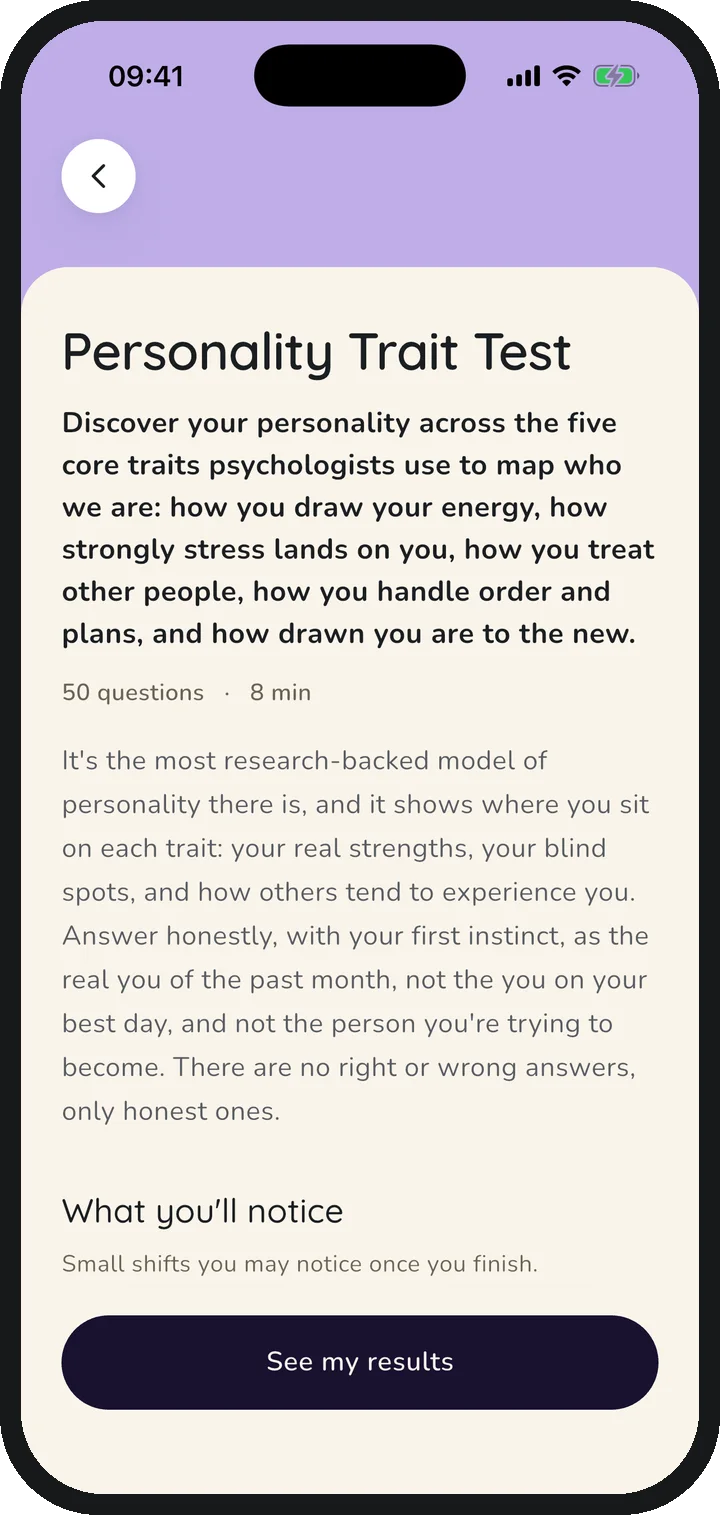
What you get in SlowMind
The test itself is only the first step. When you finish the 50 questions, SlowMind turns your answers into three things:
- A personal reading, written from your answers. Not a generic trait summary, but a reflection of your particular pattern, in plain words. No jargon, no raw scores to decode.
- Guided audio sessions built around your results. Calm, slow sessions that work with your profile rather than against it.
- Daily insight cards. Small, quiet observations drawn from your results, one at a time, so the reading keeps unfolding instead of being read once and forgotten.
The aim throughout is the same: to hold up a clear mirror, and then give you unhurried ways to sit with what you see.
Take the Big Five test in SlowMind
50 questions, about 8 minutes, and a personal reading written from your own answers.
Frequently asked questions
How long does the Big Five personality test take?
The Personality Trait Test in SlowMind has 50 questions and takes about 8 minutes. There is no time limit, so you can move at whatever pace feels honest.
Is the Big Five test accurate?
The five-factor model is the most-validated framework in personality psychology, replicated across decades of research and many cultures. Like any self-report test, though, it reflects how you see yourself. Treat the result as a mirror rather than a verdict.
Can my Big Five scores change over time?
Traits are fairly stable in adulthood, but they are not fixed. Scores tend to shift gradually with age and life experience, and most people become somewhat more agreeable, conscientious and emotionally settled over time. Retaking the test after a year or two can be a quiet way to notice that movement.
Is it free?
The app is free to download and your first test is free to try. Premium unlocks every test, full readings, and the audio library.
Is this therapy?
No. SlowMind is a tool for reflection and self-knowledge. It is not therapy, diagnosis, or treatment, and it is not a substitute for professional mental health care.