 slowmind
The Emotional Intelligence Test
40 questions · about 6 minutes · in the SlowMind app
Most of us can say what we think. Saying what we feel, in the moment we feel it, is harder. Emotional intelligence, usually shortened to EQ, is the set of skills that closes that gap: noticing your own emotions, steering them, reading other people, and handling the relationships in between.
The emotional intelligence test in SlowMind is a 40-question EQ test that takes about six minutes. It looks at how you currently operate across four dimensions: Self-Awareness, Emotion Regulation, Social Reading, and Relationship Management. Together they give a practical picture of how you handle emotional situations, from a tense meeting to a difficult message you have been putting off.
It is not a verdict on your character, and it will not tell you what to do. Like everything in SlowMind, it works as a mirror, not advice: a clear reflection of where your emotional skills are already strong and where they are still thin.
What emotional intelligence actually is
EQ is often described as if it were a single number you either have or lack. That framing is misleading. Emotional intelligence is closer to a bundle of learnable skills, the way listening, writing, or negotiating are skills. Some people arrive at adulthood with more practice in them, usually because of the family or culture they grew up in, but nobody is locked in place.
A useful EQ quiz, then, is not trying to grade you. It is trying to show you the shape of your current habits: which emotional moves come naturally to you, and which ones you tend to skip. Once you can see the shape, you can work on it deliberately instead of repeating the same patterns and wondering why the same situations keep going wrong.
The four dimensions, in plain words
Self-Awareness
Noticing what you feel while you are feeling it, and naming it accurately. Not just "bad" or "stressed", but disappointed, embarrassed, resentful, tired. People low on this dimension often discover their feelings hours later, or only when someone else points them out.
Emotion Regulation
The space between feeling something and acting on it. Regulation is not suppression; it is the ability to stay steady enough to choose your response rather than being carried by the first impulse. It shows up in how you handle criticism, waiting, and frustration.
Social Reading
Picking up what other people feel from tone, pacing, posture, and the things they do not say. Strong social readers notice when a room shifts. Weaker ones tend to take words at face value and get blindsided by reactions they never saw building.
Relationship Management
Putting the first three skills to work between people: repairing after an argument, giving feedback without wounding, saying no without drama, asking for what you need. This is where emotional intelligence stops being private and starts changing your daily life.
Why EQ often matters more day to day than IQ
Raw intelligence decides how quickly you solve abstract problems. But very little of an ordinary day is an abstract problem. Most of it is people: a colleague who went quiet, a partner who is short with you, a child melting down, your own irritation arriving before your reasons do.
That is why two equally clever people can have very different lives. The one who can read the room, cool down quickly, and repair small ruptures tends to have smoother work relationships, fewer escalations, and less lingering resentment at home. Not because their thinking is sharper, but because the friction of everyday life is mostly emotional, and they have the tools for it.
EQ is trainable, and awareness comes first
You cannot regulate an emotion you have not noticed, and you cannot repair a rupture you did not see happen. That is why every serious approach to emotional skills starts with awareness. An emotional intelligence check like this one gives you a starting point: a snapshot of where you are now, in language specific enough to act on.
From there, progress is unglamorous and real. Naming feelings a little earlier. Pausing a little longer before replying. Asking one clarifying question instead of assuming. None of it requires a personality transplant; it requires knowing which skill to practise, which is exactly what the four-dimension breakdown is for.
What the questions look like
The test uses plain, situational statements. You read each one and mark how much it sounds like you, from strongly disagree to strongly agree. There are no trick questions and no right answers.
Sample question style: "When a conversation suddenly turns tense, I can usually tell what shifted." · "I notice I am getting irritated before other people can see it." · "After a disagreement, I am usually the one who reaches out first."
The most useful results come from answering with your first instinct, based on how you actually behave, not how you would like to. The test measures habits, and habits only show up when you answer honestly.
What you get in SlowMind
The emotional intelligence test is one of the guided self-discovery tests inside SlowMind. When you finish, you do not get a bare score. You get:
- The test itself: 40 questions, about six minutes, at your own pace.
- An AI-personalised reading written from your actual answers, in plain words, with no jargon and no raw numbers. It describes how your four dimensions interact and where the friction in your days likely comes from.
- Guided audio sessions built around your results, so the practice matches the skills your reading points to.
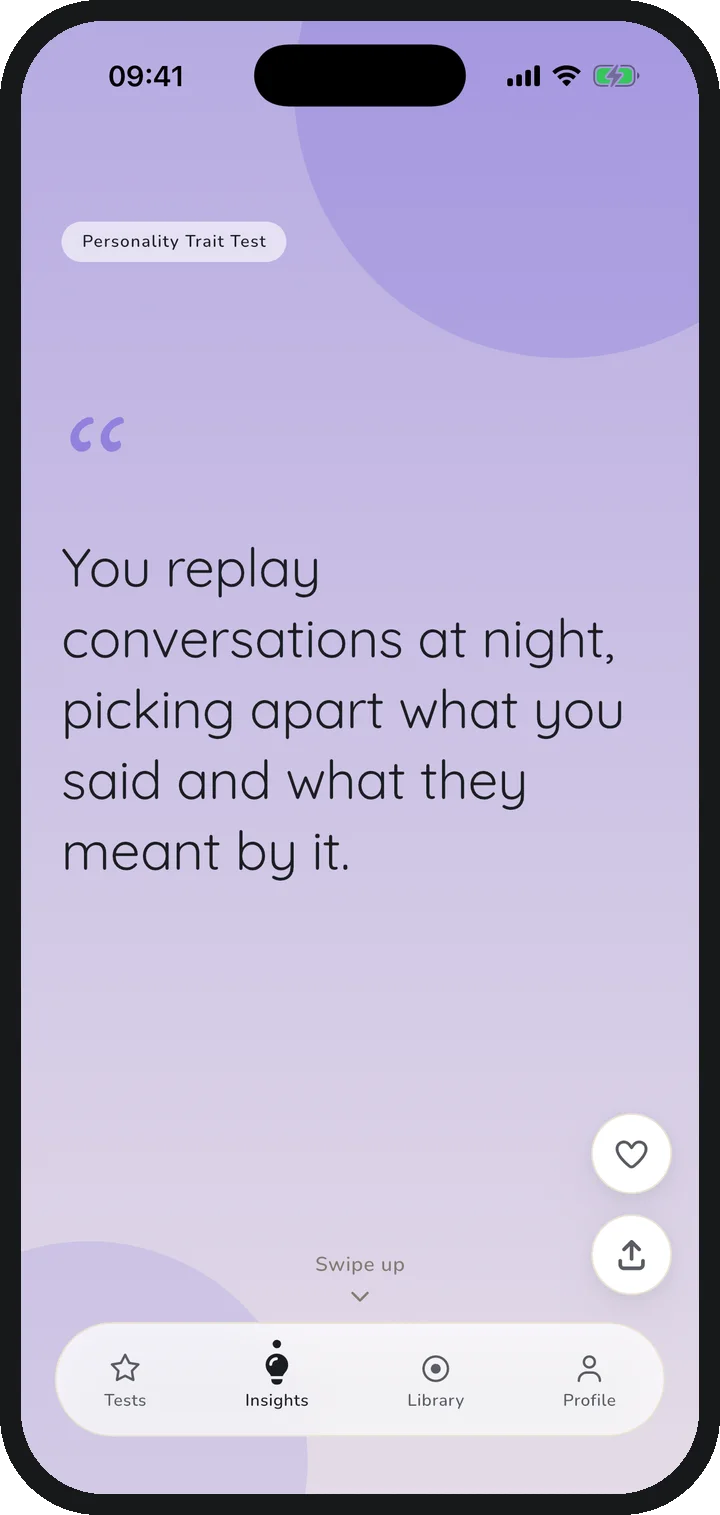
- Daily insight cards that keep the reflection going in small, quiet doses.
Take the Emotional Intelligence Test in SlowMind
Six unhurried minutes, and a clearer picture of how you handle what you feel.
Frequently asked questions
How long does the emotional intelligence test take?
The EQ test in SlowMind has 40 questions and takes about 6 minutes. There is no time limit, so you can go at your own pace.
Is it free?
The app is free to download and your first test is free to try. Premium unlocks every test, full readings, and the audio library.
Is this therapy?
No. SlowMind is a tool for reflection. It is not therapy, diagnosis, or treatment, and it is not a substitute for professional mental health care.
Can my EQ change over time?
Yes. Emotional intelligence is a set of skills rather than a fixed trait, so your results can shift as you practise. Retaking the test after a few months is a good way to see the movement.
How accurate is a self-report EQ test?
Like any self-report questionnaire, it reflects how you see yourself, which is part of the point. Honest, first-instinct answers give the clearest picture, and the results are best read as a mirror rather than a verdict.