 slowmind
The Locus of Control Test
21 questions · about 4 minutes · in the SlowMind app
Something goes wrong: an exam, a promotion that went to someone else, a month when the money ran out early. Before you have decided anything, your mind has already reached for a reason. Maybe you should have prepared more. Maybe the manager had a favourite. Maybe it simply was not your year.
That first reflex is what a locus of control test looks at. The Locus of Control test in SlowMind is 21 short statements and takes about four minutes. It asks one question: does life happen to you, or because of you? It measures where you look for reasons when things go well or badly: your own hands, the people with power around you, or luck and timing.
Most people use all three. The mix matters more than the winner. This is a mirror, not a verdict.
What locus of control means
"Locus" is simply Latin for place. Your locus of control is where you place the cause of what happens to you. The idea was introduced by the American psychologist Julian Rotter in 1966. He described it as a single line, running from internal (outcomes come mostly from what I do) to external (outcomes come mostly from forces outside me).
In the 1970s, the psychologist Hanna Levenson argued that "external" was really two different things. Feeling that your boss or your family decides your fate is not the same as feeling that it all comes down to chance. Her multidimensional model split the outside into powerful others and chance.
SlowMind's test borrows that three-part idea and asks about it with its own everyday statements. It is not one of the published research scales, and it is not a clinical measure. It is a tool for noticing a habit of mind.
The three sources, in plain words
Your own hands
Outcomes come mostly from your own choices and effort: how you prepared, what you saved, what you did next. When this source is strong, you act, you try again, and you do not wait to be rescued. The cost is weight: you can carry results that were never fully yours, and a bad outcome can feel like a verdict on you.
The people with power around you
A manager's opinion, a family's expectations, a decision made by someone you will never meet. When this source is strong, you read real power clearly: who decides, who to ask, how the system works, and you blame yourself less when a door stays shut for reasons that are not about you. The cost is waiting: for a yes, for permission, for someone else to move first.
Luck and timing
Which exam questions came up, who you happened to meet, when a job opened. When this source is strong, you bring humility, calm with uncertainty, and grace when things go wrong. The cost is that you may call your own hard-won results lucky, and hold back the push that would have paid.
Why the mix matters more than the winner
The three sources are scored separately, so they do not add up to 100. You can be high on all three, low on all three, or anywhere in between.
Two people can share a top score and live very differently. Someone at 75% own hands with luck close behind works hard and still thanks the timing. Someone at 75% own hands and little else carries every result alone: every win is earned, so every miss is theirs too. Same winner, different story.
The mix also shows something few people notice: we often file our wins and our losses in different drawers. One person credits luck for every success and keeps every failure for themselves. Another does the reverse.
No setting is the right one
It is easy to assume that "it is all up to me" is the grown-up answer and that pointing to luck or power is an excuse. This test does not work that way. Effort matters, people with power do shape outcomes, and timing is real.
Your mix also colours how you read other people. A strong sense of your own hands can treat a friend's struggle as an effort problem. A strong sense of luck forgives quickly, and can call someone's hard work lucky. The point is to know which lens you are wearing, so you can use it on purpose rather than by reflex.
What the questions feel like
Each question is a short statement about everyday life, and you answer on a five-point scale from strongly disagree to strongly agree. The statements cover exams, money, work, health, friendships and partners. A typical one looks like this:
Looking at what I have today, I see a lot of luck in it.
Strongly disagree · Disagree · Neutral · Agree · Strongly agree
Agreeing does not mean you did not work for what you have. It means luck is one of the explanations you reach for. Answer with your first instinct, as the real you of the past month. There are no right or wrong answers, only honest ones.
What you get in SlowMind
The Locus of Control test sits in the Values & Decisions section of SlowMind. When you finish, you receive:
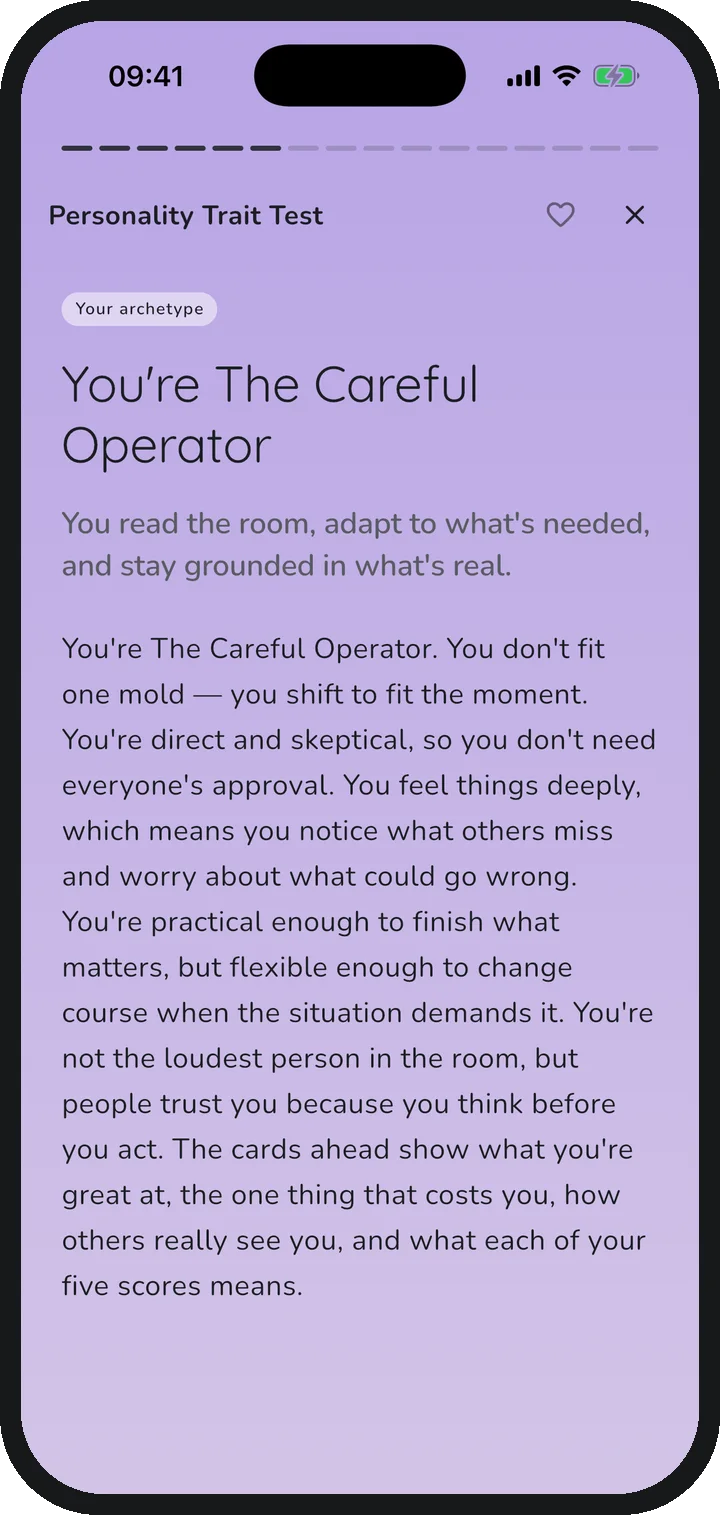
- A personal reading written by AI from your own answers, in plain words. It shows your full percentage breakdown across your own hands, the people with power around you, and luck and timing, the explanation you reach for first when something goes wrong, and where your sense of control helps you and where it quietly costs you.
- Insight cards to keep and return to, on the source you barely count, how you judge other people's wins and struggles, and what is genuinely yours to move.
- Guided audio courses picked for your result, best fit first, from three courses of six short sessions each. Not All on You helps you carry your fair share of a bad outcome and no more. Your Hand on the Wheel helps you find the levers you do hold and ask plainly. Room for Luck helps you get ready for good timing and notice your own part in what goes well.
Take the Locus of Control test in SlowMind
Four quiet minutes, and a clearer look at where you place the reasons for your life.
Frequently asked questions
How long does the Locus of Control test take?
It is 21 statements and most people finish in about four minutes. There is no timer, so you can take longer if you need to.
Is it free?
The app is free to download, and your first test, the one chosen for you when you join, is free. Premium unlocks every test, full readings, and the audio library.
Is this therapy?
No. The Locus of Control test is a tool for reflection. It is not therapy, diagnosis, or treatment, and it is not a substitute for professional support if you need it.
Is an internal locus of control better?
SlowMind does not treat any mix as the right one. Each source is partly right about real life, and each one has a cost. The reading shows what yours gives you and what it takes.
Why don't my three percentages add up to 100?
Each source is measured on its own, with seven statements each. They are not slices of one pie, so you can be high on all three or low on all three.
Is this the Rotter or Levenson scale?
No. The test borrows the three-part idea from that research but uses its own everyday statements. It is not one of the published research scales and it is not a clinical measure.