 slowmind
The Love Languages Test
25 questions · about 4 minutes · in the SlowMind app
Most people can name the five love languages without much thought. Far fewer know their own shape. Knowing that you lean towards quality time is a start. Knowing how far it leads, and which language barely registers for you at all, is where the useful part begins.
The Love Languages test in SlowMind is 25 short statements that take about four minutes. It shows how you most naturally give and receive love, as a percentage across all five languages rather than a single label. A 35% words, 25% time split tells a very different story from 90% words and 5% everything else.
It is not a verdict on your relationship. It is a mirror for one question: what actually makes you feel loved, and what you might miss when love arrives in a different form.
Where the five love languages come from
The idea comes from Gary Chapman's 1992 book, The Five Love Languages. His observation was simple: people express and recognise love in different ways, and partners often give love in the way they would most like to receive it. Two people can both be trying hard and still feel unloved, because each is speaking a language the other barely hears.
In plain terms, the five are:
- Words of affirmation: praise, appreciation, hearing "I'm proud of you".
- Quality time: undivided attention and being truly present together.
- Receiving gifts: thoughtful tokens that say you were on someone's mind.
- Acts of service: practical help that lightens the load.
- Physical touch: closeness, a hug, a hand on the shoulder.
A word on the science. The love languages are a popular idea rather than a clinical one, and research that has tested them has found mixed support. Many people value all five to some degree. So SlowMind treats them as a useful lens for noticing and talking about what you need, not as a validated diagnostic, and the test is not a published psychological scale.
Why the shape matters more than the winner
Many love language quizzes hand you one word and stop there. What changes how a relationship feels is the spread underneath it.
Some profiles are spiky: one language towers over the rest. Love reaches you in one clear, specific way, and you can feel starved when it is missing, even while care is shown in other forms. A partner can cook, fix things and plan every weekend, and you can still feel strangely unseen because nobody has said anything.
Other profiles are balanced, with two or three languages close together. You are easier to reach, because several channels work. The catch is that your needs are easy to under-read. Nothing shouts, so people assume nothing is needed.
Then there is your quietest language, the one that scores lowest. It is usually the gesture you forget other people need, or the one you shrug off when it is offered.
The give and receive gap
Here is the pattern most people never notice in themselves: we tend to give love in our own top language. The words person writes long, careful messages. The quality time person clears an evening. The acts of service person quietly does the washing up. Each is a real gift. Each can land softly, or not at all, on someone who listens for something else.
From the inside, the near miss feels confusing. They are trying, and you still feel unseen. Neither of you is doing it wrong. You are simply fluent in different languages, and nobody has said so out loud.
Seeing your own percentages makes this easier to talk about. A shape is something you can hand to someone as a map, rather than a complaint.
A snapshot, not a label
Love languages are not fixed for life. What fills you during a demanding year at work may differ from what fills you in a quiet one. A new baby, a move or a long-distance stretch can all change what you most need. That is not inconsistency. It is a life responding to its season.
The statements talk about "someone" and "the people I love", not only a partner, so the result applies to friends and family too. Answer as the real you of the past month, not the person you wish you were.
What the questions feel like
Each question is a short, plain statement. You rate how true it feels on a five-point scale and go with your first instinct. A typical one looks like this:
I'd rather have one focused hour with someone than a whole day of them half-present.
Strongly Disagree · Disagree · Neutral · Agree · Strongly Agree
There are five statements for each language, and one in each set is phrased the other way round, which keeps the answers honest. There are no right or wrong answers, only honest ones.
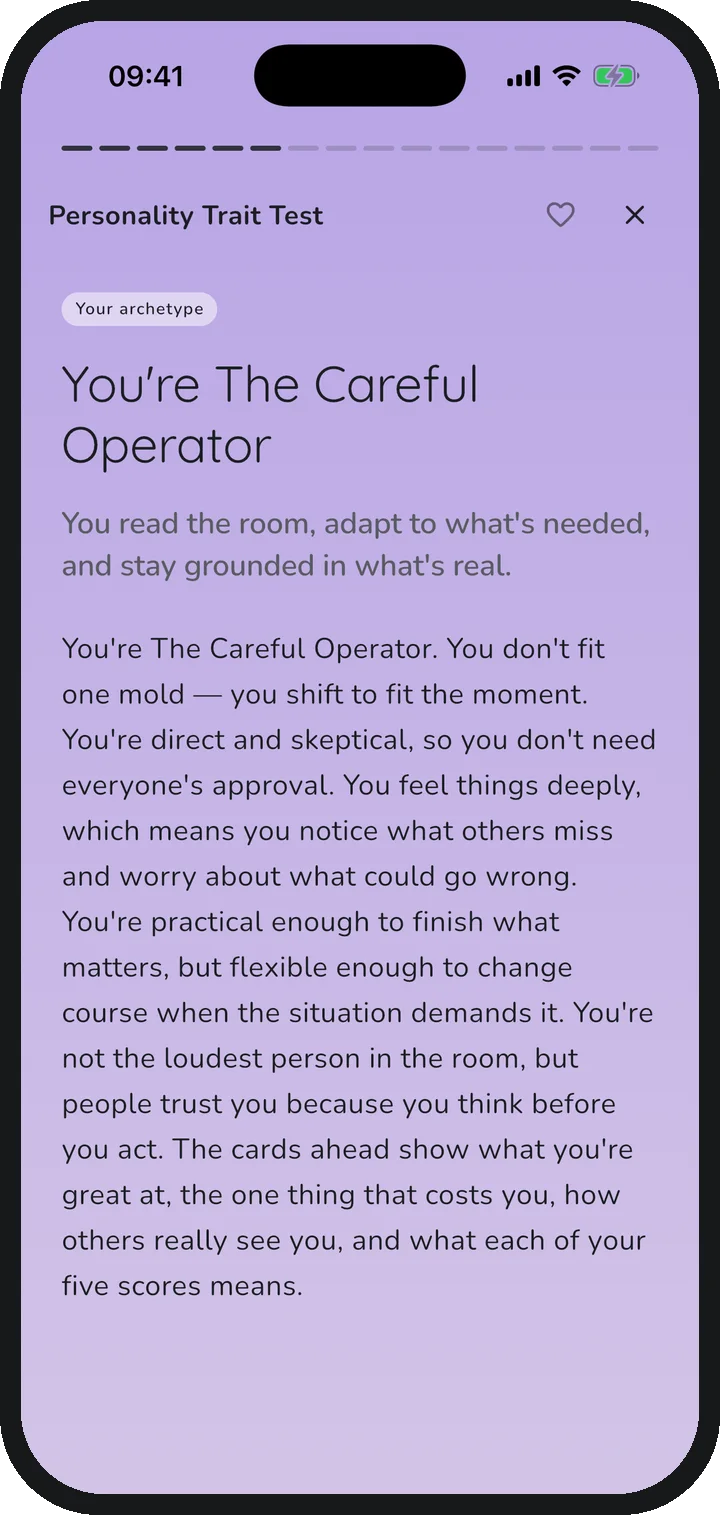
What you get in SlowMind
The Love Languages test sits in the Relationships section of SlowMind. When you finish, you receive:
- Your full breakdown, with a percentage for each of the five love languages, so you see the whole shape and not just the winner.
- A personal reading, written by AI from your own answers in plain words. It covers what fills you, the language you barely speak, how you give compared with how you receive, where you and a partner are most likely to miss each other, and the specific gestures that land deepest for you.
- Insight cards to keep and return to, so the findings stay in view instead of fading after the first read.
- Guided audio courses picked for your result, best fit first, from three courses of six short sessions each. Tell Me, Show Me is for people led by words or gifts. Close and Present is for people led by quality time or touch. Love That Lifts the Load is for people led by acts of service.
The reading is generated from your own answers and percentages, not pulled from a stock paragraph about your top language.
Take the Love Languages test in SlowMind
Four unhurried minutes, and a clearer picture of how love actually reaches you.
Frequently asked questions
How long does the Love Languages test take?
It is 25 short statements and most people finish in about four minutes. There is no timer, so you can take longer if a statement deserves more thought.
Is it free?
The app is free to download, and your first test, the one chosen for you when you join, is free. Premium unlocks every test, full readings and the audio library.
Is this therapy?
No. The Love Languages test is a tool for reflection. It is not therapy, diagnosis or treatment, and it is not a substitute for professional support if you need it. If a relationship feels painful or unsafe, please reach out to a qualified professional.
Are the five love languages scientific?
They come from Gary Chapman's 1992 book rather than from clinical research, and studies that have tested the idea have found mixed support. SlowMind uses them as a useful lens for reflection and conversation, not as a validated diagnostic, and the test is not a published psychological scale.
Will I only get one love language?
No. You see a percentage for each of the five, and your reading looks at the whole shape: how far your top language leads, how close the others are, and which one barely registers for you.
Can my love language change?
Yes. What fills you can shift with stress, life stage and the relationship you are in. Answer as the real you of the past month, and come back to the test when life changes shape.